Take-Off at Cranfield University as WWII Hangars get Energy Efficiency Refurb
News
Adam Howlett
Est. Reading time: 3 Minutes
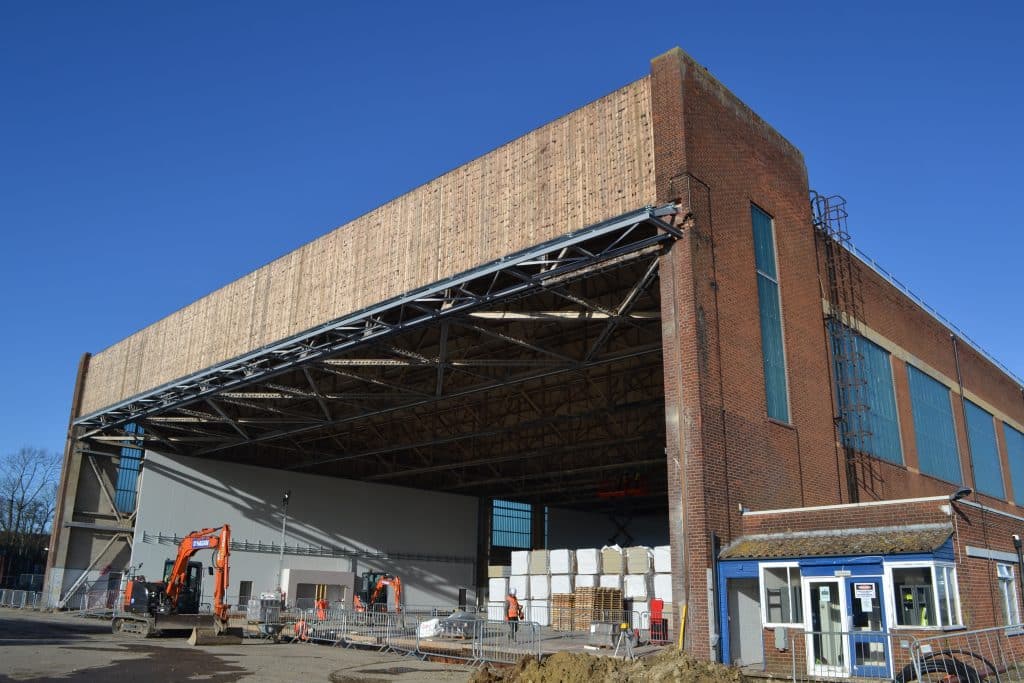
Two pre-WWII RAF hangars at Cranfield University are to receive a major refurbishment by one of East Anglia’s leading construction companies, R G Carter, to improve their energy efficiency and carbon footprint.
Built in 1936, the 4,200 m2 hangars were originally built in preparation for WWII and are today occupied by Cranfield University for research and maintenance purposes. The refurbishment, designed by R G Carter’s internal Architectural and Engineering design team at CDG, will transform the thermal performance and efficiency of the hangars with the aim of significantly reducing the carbon footprint of the buildings.
“We’re delighted to have R G Carter and CDG once again on board as lead contractors and designers for the project,” says Gareth Ellis, Energy and Environment Manager at Cranfield University. “The refurbishment and decarbonisation of these two historic WWII hangars will ensure they continue to service the University for many more years to come, whilst also supporting our steps towards net zero carbon emissions by 2030.”
The work is being made possible by an award through the Public Sector Decarbonisation Scheme (PSDS) which is funded by the Department for Business, Energy, and Industrial Strategy (BEIS) and delivered by Salix Finance.
R G Carter’s Project Manager, Dan Cox, said: “We’re thrilled to be working on yet another significant project for Cranfield University. This will be our fifth major project with Cranfield University in five years, following the successful completion of the Aerospace Integration Research Centre (AIRC), the Digital Aviation Research and Technology Centre (DARTeC), Agri-informatics building and Cranfield Airport Fire Station on its campus.
“The refurbishment and the decarbonisation of the two hangars has already begun and we expect the project to complete later this autumn,” added Dan.
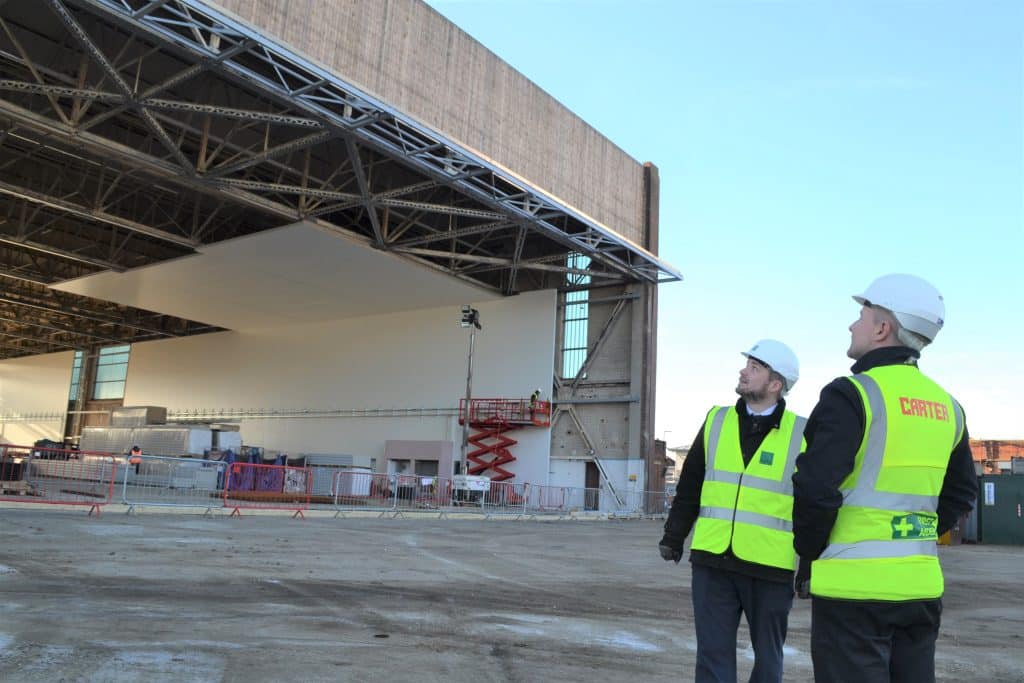
To provide a sustainable solution, CDG designed an insulated, air-tight ‘box within a box’ which sits inside the hangar, installed with new mechanical, electrical and plumbing (MEP) works such as ventilation and lighting by Briggs and Forester.
“The original plans for the refurbishment were to remove and replace the entire cladding and saw-tooth roof from the hangars,” explains Andrew Grant, Principal Architectural Designer at CDG, “On further exploration we realised we could create a much more environmentally sustainable solution that is more cost efficient and quicker to deliver. Creating a ‘box within a box’ also extends the life of the hangars and preserves the heritage of the facades, with the fitting of new steel-framed insulated automatic doors further improving the thermal efficiency of the hangars.”
Once the work is completed, the heating demand of the buildings will be reduced by 75% and the carbon footprint reduced even further when connected to the district heating newly fitted with air source heat pumps, also funded through the project.
The Public Sector Decarbonisation Scheme has been made available for capital energy efficiency and heat decarbonisation projects within public sector non-domestic buildings, including central government departments and non-departmental public bodies in England only, to provide the following objectives:
1. Deliver stimulus to the energy efficiency and heat decarbonisation sectors, supporting jobs.
2. Deliver significant carbon savings within the public sector.
To provide the best experiences, we use technologies like cookies to store and/or access device information. Consenting to these technologies will allow us to process data such as browsing behaviour or unique IDs on this site. Not consenting or withdrawing consent, may adversely affect certain features and functions.
Functional
Always active
The technical storage or access is strictly necessary for the legitimate purpose of enabling the use of a specific service explicitly requested by the subscriber or user, or for the sole purpose of carrying out the transmission of a communication over an electronic communications network.
Preferences
The technical storage or access is necessary for the legitimate purpose of storing preferences that are not requested by the subscriber or user.
Statistics
The technical storage or access that is used exclusively for statistical purposes.The technical storage or access that is used exclusively for anonymous statistical purposes. Without a subpoena, voluntary compliance on the part of your Internet Service Provider, or additional records from a third party, information stored or retrieved for this purpose alone cannot usually be used to identify you.
Marketing
The technical storage or access is required to create user profiles to send advertising, or to track the user on a website or across several websites for similar marketing purposes.